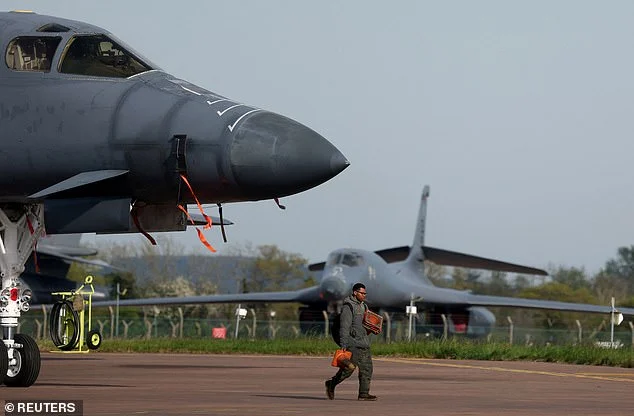
Iran has declared Britain’s RAF Fairford a "legitimate target" after the U.S. launched a B-1 bomber raid from the Gloucestershire base earlier this week. The Islamic Revolutionary Guard Corps (IRGC) warned the UK against continued support for American military operations against Tehran, marking a sharp escalation in regional tensions.
US B-1 Bomber Raid from RAF Fairford
The B-1 Lancer, capable of carrying two dozen 2,000-pound bombs, took off from RAF Fairford on Tuesday, according to U.S. news outlet Axios. This mission represents the first such operation from the UK since Prime Minister Andy Burnham assumed office following Sir Keir Starmer’s resignation. It also marks the first U.S. B-1 sortie since hostilities with Iran resumed nearly two weeks ago.
Bloomberg reported that Burnham approved the use of British military bases, including RAF Fairford and Diego Garcia in the Chagos Islands, for "defensive strikes." The IRGC statement, carried by Iran’s IRNA news agency, accused the U.S. of depleting its cruise missile reserves before shifting to B-1 bombers from the UK. "Any base used to invade Iranian territory is our legitimate target," the statement added.
Iran’s Broader Threats and Regional Fallout
The IRGC’s warning extended beyond RAF Fairford, condemning Britain’s historical role in the Middle East. The statement accused the UK of "widespread massacres" in Islamic countries, "imposing authoritarian governments," and facilitating "the occupation of Palestine and the creation of the Israeli Nakba." The Nakba refers to the 1948 displacement of Palestinians during the Arab-Israeli war.
Tensions have spilled into global energy markets. Oil prices surged above $100 a barrel for the first time in two months after Iran-backed Houthi militants attacked two Saudi oil tankers in the Red Sea. The Houthis, who control northern Yemen, announced a maritime blockade on Saudi Arabia, threatening to disrupt 7% of global maritime traffic through the Bab el-Mandeb Strait. Five tankers altered course to avoid the area on Wednesday, while three Saudi oil shipments bound for China and India reversed direction.
- Oil prices climbed to $100/barrel after Houthi attacks on Saudi tankers
- Iran’s near-total blockade of the Strait of Hormuz has already disrupted 20% of global oil and LNG flows
- Houthi threats could force Saudi oil shipments to reroute through the Suez Canal, adding weeks to transit times
US and Iran Exchange Strikes as Diplomatic Tensions Rise
The U.S. conducted its 12th consecutive night of airstrikes against Iran on Wednesday, targeting maritime capabilities, missile storage, and air defense sites. U.S. Central Command (CENTCOM) stated the strikes were intended to "degrade Iran’s ability to threaten civilian mariners and commercial vessels." Iran responded by attacking U.S. bases in Kuwait and Jordan, claiming to have destroyed radar systems, Patriot missile batteries, and helicopter hangars.
President Donald Trump escalated rhetoric, vowing to destroy an Iranian bridge or power plant for every ship targeted in the Strait of Hormuz. Iran’s Foreign Minister Seyed Abbas Araghchi matched the tone, promising an "eye for an eye" response. Meanwhile, the UK withdrew diplomatic staff from Iran, citing security risks, and advised against all travel to the country.
A UK government spokesperson reaffirmed the nation’s defense posture, stating: "Our Armed Forces are ready to keep the United Kingdom safe from any kind of attacks... The UK stands ready 24/7 to defend itself, acting in accordance with international law." Observers will watch for further Iranian retaliation, potential disruptions to Red Sea shipping, and whether the UK reassesses its support for U.S. military operations from British soil.