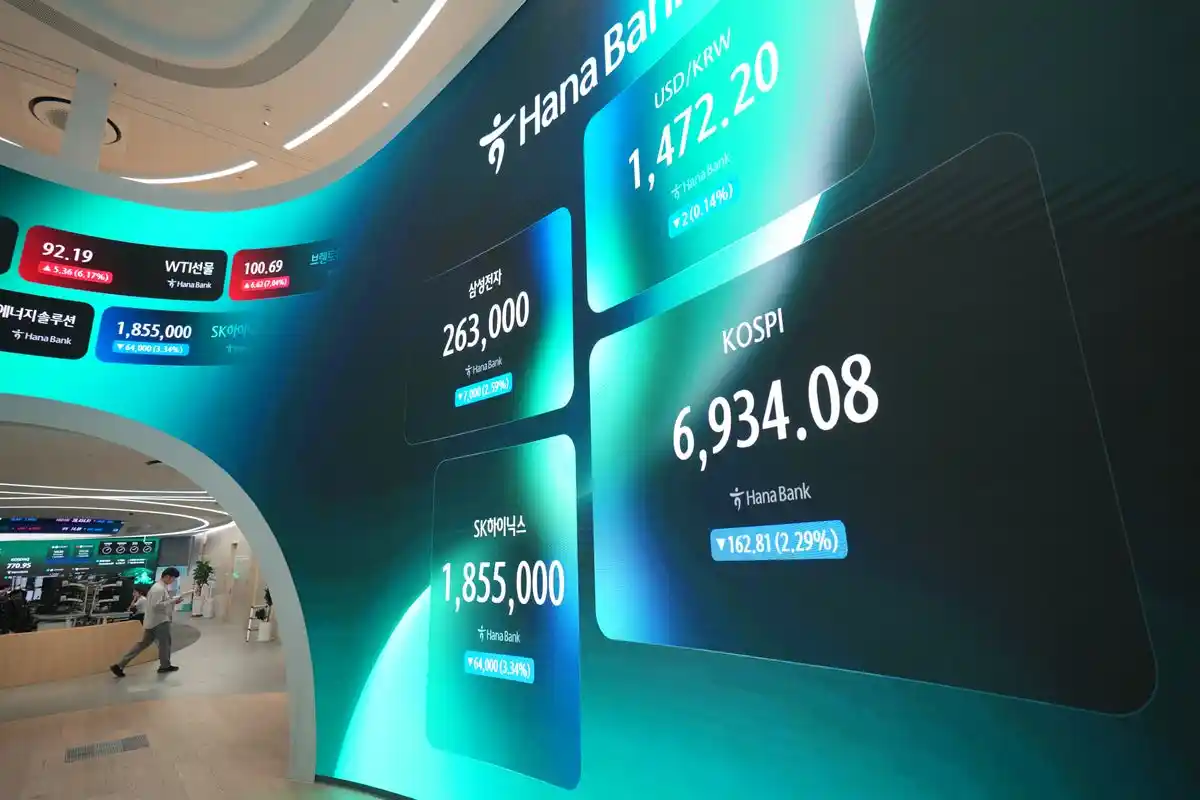
Asian stock markets experienced a significant downturn Friday, with major indices declining sharply as Brent crude oil prices surged past $100 per barrel. The sell-off was amplified by investor concerns over artificial intelligence (AI) investments and escalating geopolitical tensions in the Middle East.
AI Stock Sell-off and Market Declines
Investor sentiment soured globally as shares in prominent AI-related companies experienced substantial drops. In South Korea, the Kospi index fell 5.9% to 6,681.98, led by an 8% decline in Samsung Electronics and a 7.4% drop in chipmaker SK Hynix. Tokyo's Nikkei 225 mirrored this trend, closing down 3.1% at 64,377.28, with SoftBank Group, a major AI investor, losing 7.5%.
Hong Kong's Hang Seng index shed 1.3% to 24,891.84, and Shanghai's Composite index declined 1.2% to 3,830.19. These declines followed a rough trading session on Wall Street, where US futures showed little movement after significant losses for Alphabet and Tesla, marking the worst day for US stocks in a month.
Rising Oil Prices and Geopolitical Tensions
The escalating crisis in the Middle East significantly impacted oil markets. Brent crude oil reached its highest price since May, closing at $100.69 per barrel on Thursday, a 7% increase. This surge was attributed to attacks on two Saudi oil tankers in the Red Sea, threatening vital global oil and gas transport routes, including the Strait of Hormuz.
US benchmark crude also saw a slight dip, falling 0.5% to $91.71 per barrel. In response to the threats against shipping, US President Donald Trump warned of "major military punishment" against Houthi rebels in Yemen, who are backed by Iran, if they continue their attacks.
Broader Economic Headwinds
Beyond oil prices, broader economic uncertainties are weighing on markets. US President Donald Trump's administration announced new tariffs, imposing taxes of 10% to 12.5% on imports from 60 trading partners, citing their failure to fully enforce bans on goods produced by forced labor. This move came as temporary levies imposed by the president were nearing their expiration.
These cumulative uncertainties have contributed to a significant weakening of the US dollar against the Japanese yen, reaching a 40-year high. A dollar bought 163.83 yen early Friday, a level not seen since 1986. The euro remained largely stable at $1.1378.
Rising oil prices can increase business costs and reduce consumer spending power, potentially leading to higher inflation. Such a scenario could prompt central banks, including the Federal Reserve, to consider raising interest rates, which could further slow economic growth and dampen investment prices. The European Central Bank, however, maintained its key interest rates at its meeting on Thursday.
Company-Specific Shocks
Specific corporate performance also contributed to market volatility. Tesla shares plunged 14.5% after the electric vehicle manufacturer reported a weaker-than-expected profit for its latest quarter. As one of the largest companies by market value in the S&P 500, Tesla's performance has a considerable influence on the broader index.
Alphabet, the parent company of Google and another major S&P 500 constituent, saw its stock fall 7.1%, despite reporting stronger profit and revenue than analysts predicted. Investors, however, focused on the company's increased capital spending forecast, particularly its planned investments in AI.
The current market dynamics highlight a complex interplay of geopolitical risks, speculative investment trends, and shifting economic policies, suggesting continued volatility may be on the horizon.