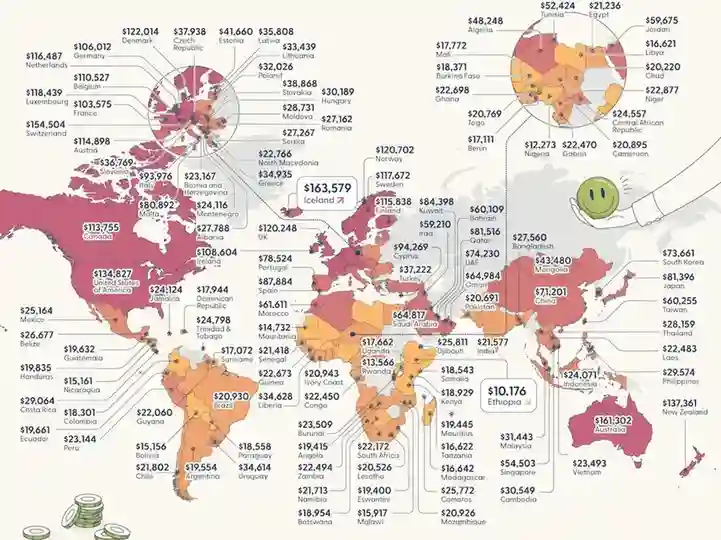
Canadians need an annual income of $155,850 to achieve happiness, according to a study that ranks the country as the 14th most expensive place in the world for emotional well-being. The findings, derived from Purdue University research and adjusted for local purchasing power, position Canada among a cluster of European nations where financial satisfaction comes at a premium.
How the Study Calculated the "Price of Happiness"
The analysis, conducted by digital financial services provider Remitly, builds on a 2018 Purdue University paper that identified the income threshold at which additional earnings no longer boost life satisfaction. Researchers applied country-specific purchasing power ratios from the International Monetary Fund and Gallup’s Life Evaluation Index to determine local "satiation points"—the income level beyond which happiness plateaus.
For Canada, this threshold was set at US$113,755 (C$155,850 at the time of calculation), placing it just below Finland and Austria but above Belgium and Ireland. The global leader was Iceland, where happiness was priced at US$163,579, while Ethiopia ranked lowest at US$10,176.
City-Level Disparities Across Canada
Within Canada, the cost of happiness varies sharply by city. Victoria, Vancouver, and Toronto topped the list, with required incomes ranging from $167,000 to $170,000. Saskatoon followed at just under $160,000, while Kingston, the lowest-ranked city surveyed, still demanded over $140,000.
- Victoria: $170,000
- Vancouver: $169,000
- Toronto: $167,000
- Saskatoon: ~$160,000
- Kingston: $140,000+
The study noted one outlier: Slovenia, where the average annual salary (US$42,754) exceeds the country’s "price of happiness" (US$36,769). In contrast, Canada’s average salary of US$50,500 covers just 44.4% of its happiness threshold.
What the Findings Mean for Canadians
While the study’s framing is partly tongue-in-cheek, its methodology underscores the growing gap between income and perceived well-being in high-cost nations. Critics may question whether happiness can be quantified financially, but the data highlights a broader trend: in wealthy countries, rising living costs often outpace wage growth, leaving even middle-class earners below the "satiation point."
For now, the research serves as a benchmark—one that policymakers and economists may watch as debates over affordability and quality of life intensify. Whether happiness remains a moving target, or a fixed price, remains an open question.