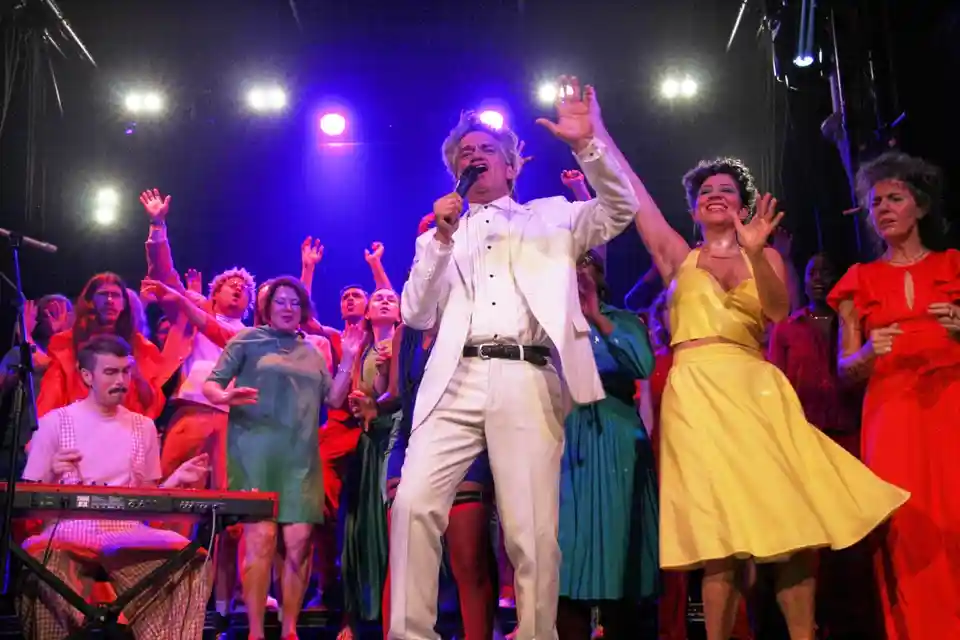
A growing trend in pop culture sees artists blending irony and sincerity to explore existential themes, a phenomenon scholars call reverent irreverence. At a recent Los Angeles concert, Australian musician Alex Cameron exemplified this approach, singing a mix of absurd and earnest lyrics about Jesus to a confused yet captivated audience.
The rise of reverent irreverence in modern art
Cameron’s song “Jesus Never Had No Porno” oscillates between humor and devotion, with lines like “Jesus never had no porno / Jesus never had cocaine” drawing scattered laughter before shifting to a more solemn tone. “But every time he spoke / The people gathered round / When he washed their feet / The demons all came out,” he sang, underscoring the song’s underlying earnestness. In an Associated Press interview, Cameron described his method: “You’ve been disarmed with laughter. Now you’re kind of open to anything. You’re open to profound sadness or hope.”
This approach reflects a broader cultural moment where younger generations, increasingly disconnected from organized religion, still engage with its themes. Kathryn Lofton, a Yale University scholar of religion and pop culture, notes that religion remains a source of power and shared language, even for skeptics. Participation in organized religion in the U.S. has declined, yet its influence persists in high-profile works, from Beyoncé’s exploration of Yorùbá spirituality to Rosalía’s 2025 album “Lux,” inspired by Catholicism and female mysticism.
Artists and the ambiguity of faith
Comedians and musicians often use irony to explore religious questions while maintaining plausible deniability. Leigh Eric Schmidt, a professor at Washington University in St. Louis, explains that this allows artists to engage with faith without fully committing to its traditions. Nathan Fielder’s HBO series “The Rehearsal” exemplifies this, as he examines interfaith relationships and antisemitism with a tone that leaves audiences questioning his sincerity. “You never know if he’s serious or not,” said Shelah Marie, a fan from Atlanta, reflecting on the appeal of such ambiguity.
Other artists, like Geese frontman Cameron Winter, blur the line between satire and devotion. In his solo album “Heavy Metal,” he declares, “God is real, God is real / I’m not kidding, God is actually real,” with a delivery that makes it difficult to dismiss as mere sarcasm. Meanwhile, anti-consumerist groups like The Church of Stop Shopping, led by Reverend Billy, use satire to critique conservative Protestantism while sincerely advocating communal values. Their work has even earned them a spot opening for Neil Young on his 2024 tour.
Faith, authenticity, and the age of AI
As artificial intelligence reshapes creativity, artists are increasingly using humor and irony to explore questions of authenticity. Sociologist George González argues that in an era where “we can no longer tell surface from depth,” reverent irreverence offers a way to grapple with transcendence. Alex Cameron, who now attends church as an adult despite not growing up religious, sees it as a way to ground himself: “Magic is real and God is real, and you know those things are pretty widely accepted, I think.”