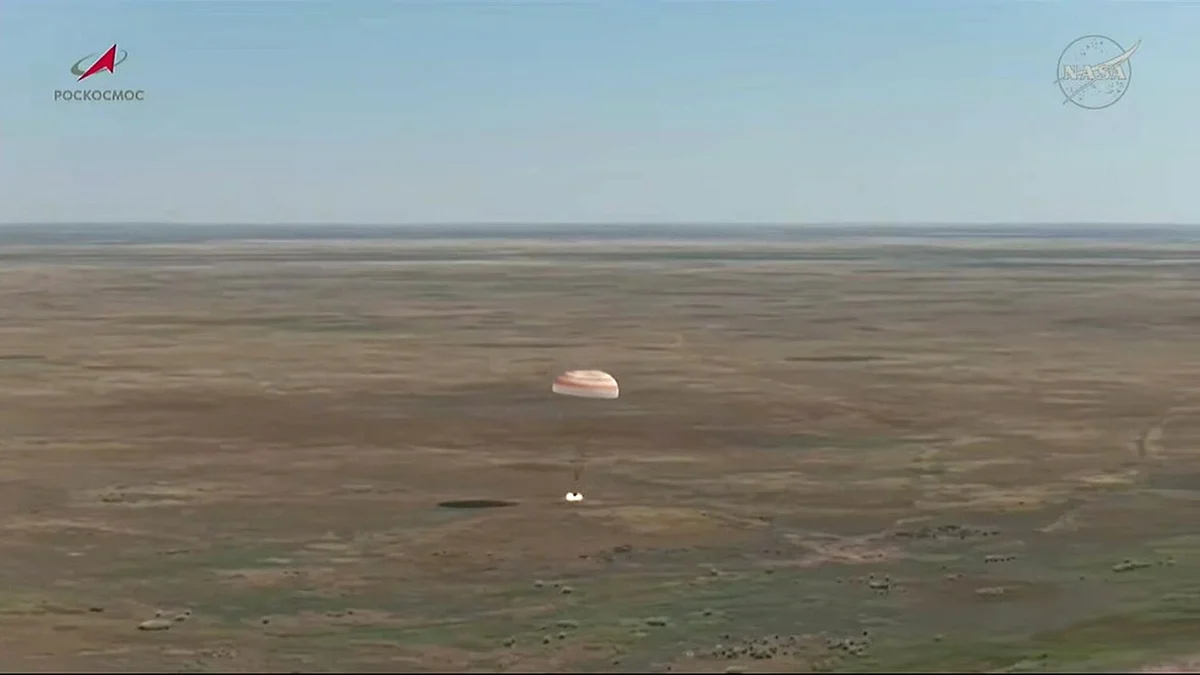
A NASA astronaut and two Russian cosmonauts returned to Earth on Sunday after spending 241 days aboard the International Space Station, touching down in Kazakhstan aboard a Soyuz spacecraft at 3:27 p.m. local time.
Precision landing concludes record-breaking mission
The Soyuz MS-28/74S ferry ship, carrying commander Sergey Kud-Sverchkov, flight engineer Sergey Mikaev and NASA’s Chris Williams, undocked from the station’s Rassvet module at 3:03 a.m. EDT before executing a controlled re-entry.
Following a four-minute, 42-second braking burn, the capsule descended through the atmosphere, deploying its main parachute for a 10-minute descent before a rocket-assisted touchdown near Dzhezkazgan. The crew completed 3,856 orbits, covering 102 million miles since their launch on November 27.
Recovery teams assist crew after weightless return
Russian recovery crews swiftly reached the landing site, extracting the trio from the cramped capsule as they readjusted to gravity. Kud-Sverchkov, a veteran of a previous 185-day mission, reported feeling "better and better with each moment," praising the landing as "smooth and perfect."
All three received medical checks, fresh fruit and personalized matryoshka dolls—one containing vodka, prompting a lighthearted remark from a crew member. Williams, completing his first spaceflight, and Mikaev were flown to Karaganda before parting ways: Williams to Houston, his crewmates to Star City near Moscow.
Scientific achievements and future ISS operations
During their mission, Williams participated in two spacewalks to repair the station’s robotic arm and prepare for new solar array installations. Kud-Sverchkov and Mikaev conducted a separate maintenance spacewalk outside the Russian segment.
Left aboard the ISS are NASA’s Crew 12, including commander Jessica Meir, and the newly arrived Soyuz MS-29 crew. A fresh NASA-sponsored crew is scheduled to launch from Florida on September 12, continuing the station’s ongoing rotation.
Williams, a former firefighter and MIT-trained astrophysicist, reflected on the experience, calling it "one of those things that a lot of kids have fascinations with, and I just never grew out of it." He added that observing Earth from orbit deepened his appreciation for the planet’s geological patterns, a perspective he hopes to apply to future lunar exploration.