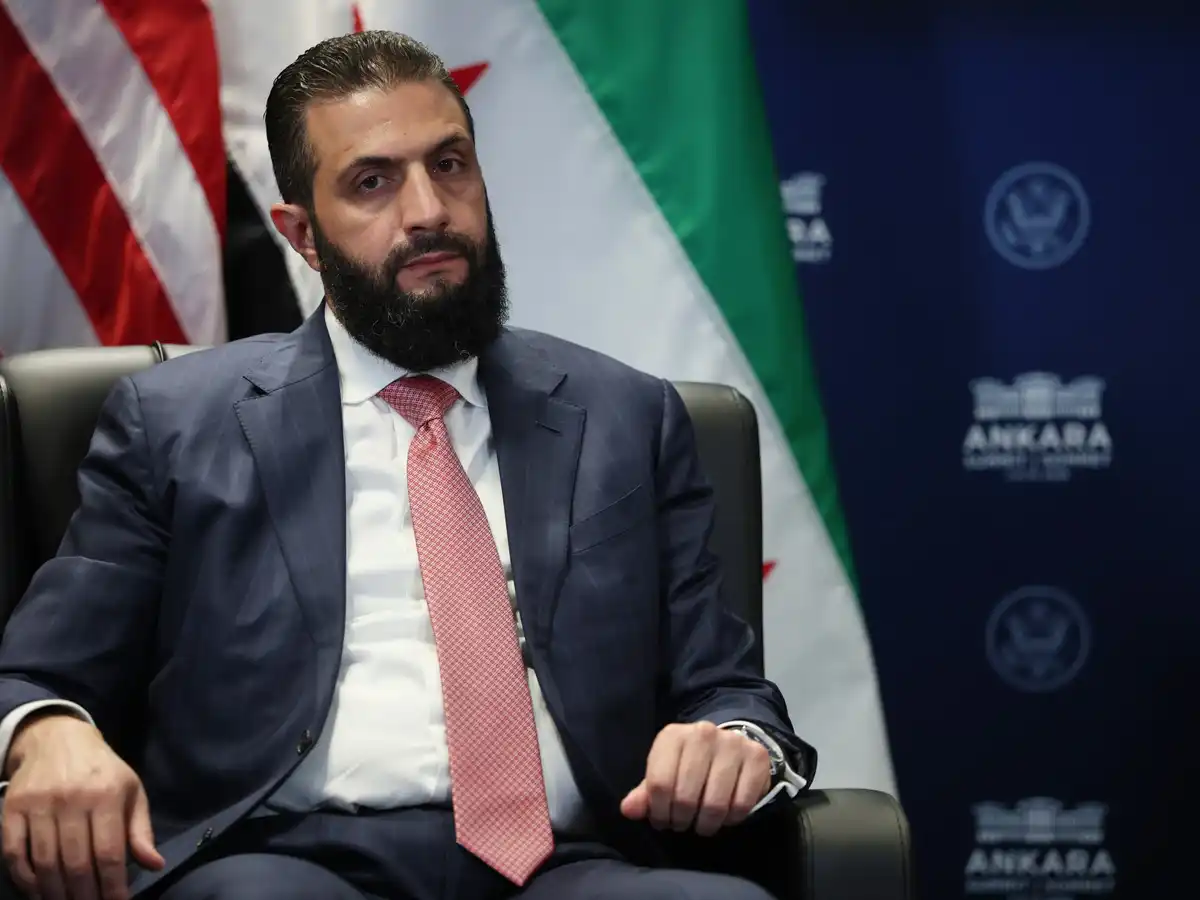
Syria’s President Ahmed al-Sharaa has overhauled the country’s security and intelligence leadership, expanding the authority of Interior Minister Anas Khattab and appointing new officials to key roles. The reshuffle, announced on Sunday, centralises oversight of Syria’s security apparatus under Khattab, who now heads both the Interior Ministry and the National Security Bureau.
Key appointments in Syria’s security reshuffle
State news agency SANA reported that Hussein al-Salamah was named deputy head of the National Security Bureau, while Mulham al-Shantout became assistant interior minister for security affairs. Abdul Qader Tahan was appointed to lead the General Intelligence Service, which handles domestic and foreign threat assessments, counterespionage, and counterterrorism.
Syrian authorities stated the changes aim to strengthen national security, promote stability, and clear obstacles to reconstruction. The General Intelligence Service now operates under Khattab’s legal authority, consolidating control of Syria’s security bodies.
Context and recent security challenges
Omer Ozkizilcik, a nonresident senior fellow with the Atlantic Council’s Syria Project, told Al Jazeera the reshuffle formalises power structures from al-Sharaa’s prior administration in Idlib, where Khattab previously oversaw overlapping intelligence and policing duties with Salamah.
The moves follow recent security incidents in Damascus, including a July 2 cafe explosion near the judicial complex that killed at least 10 people. Five days later, a blast from devices hidden in a rubbish bin and a parked car wounded 36 and killed one, coinciding with French President Emmanuel Macron’s visit. Authorities arrested suspected ISIL-linked cell members, traced via security footage.
Diplomatic shifts and regional tensions
Earlier this month, Iraqi border customs officers intercepted a shipment of missiles, rockets, and drones concealed in an oil tanker, allegedly bound for Hezbollah. The Iran-aligned group denied the claim.
Macron’s visit marked the first by a major Western leader since al-Sharaa’s transitional government formed in January 2025, following Bashar al-Assad’s December 2024 departure. France restored full diplomatic relations with Syria, and at a NATO summit in Turkiye, US President Donald Trump met al-Sharaa, with Washington later removing Syria from its list of state sponsors of terrorism.