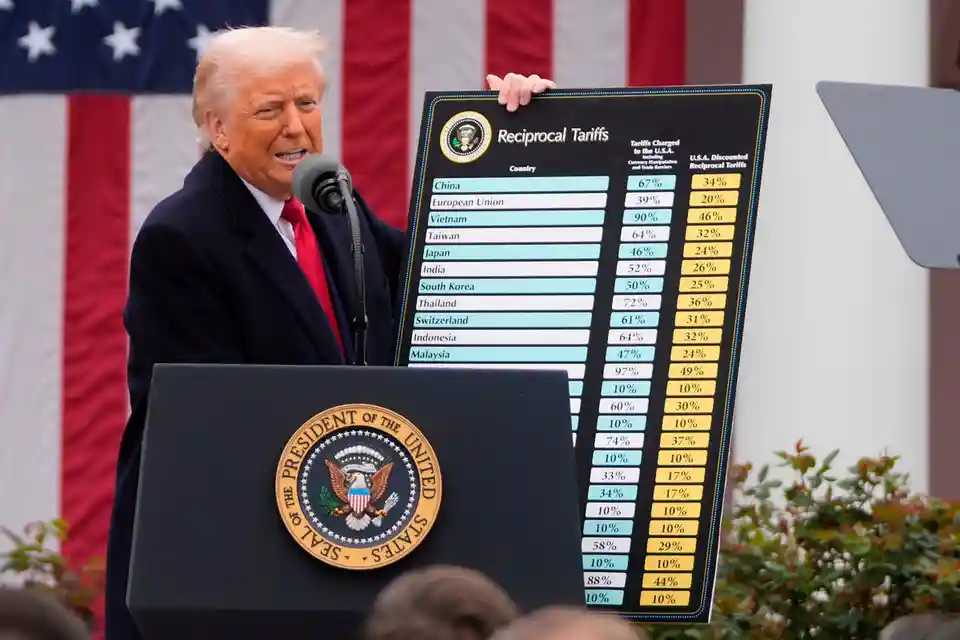
President Donald Trump will implement new double-digit tariffs on imports from 60 countries, amounting to 10% to 12.5%, effective Friday. This action follows the expiration of temporary levies imposed after a Supreme Court ruling.
New Tariffs Target Forced Labour Imports
The United States is imposing tariffs on goods from 60 nations, a move U.S. Trade Representative Jamieson Greer stated aims to address inadequate enforcement of forced labour bans. Greer commented, "The United States has had a forced labor import ban for nearly a century, and rigorously enforces it; it's well past time for our trading partners to do the same."
These new duties will replace 10% worldwide tariffs that expire at 12:01 a.m. Friday. These temporary measures were enacted after the Supreme Court invalidated broader tariffs in February.
Leveraging Trade Act for Import Sanctions
The administration is utilising Section 301 of the Trade Act of 1974, which empowers the president to enact import taxes and sanctions against countries engaging in "unjustifiable," "unreasonable," or "discriminatory" trade practices. Trump previously used this section to impose tariffs on China, which withstood legal challenges.
Further Section 301 tariffs may be forthcoming. The U.S. Trade Representative's office is investigating whether 16 countries, responsible for 70% of U.S. imports, are overproducing goods, thereby disadvantaging American companies. This investigation remains ongoing.
Trump's broader trade strategy, which reverses decades of policy favouring lower tariffs, is underpinned by the argument that these measures will revive American manufacturing. Last year, invoking the International Emergency Economic Powers Act (IEEPA), he imposed significant tariffs citing a national emergency due to the U.S. trade deficit. However, the Supreme Court ruled IEEPA did not authorise tariffs, compelling the administration to issue refunds.
In response, Trump introduced 10% worldwide tariffs under Section 122 of the Trade Act of 1974. These levies, however, are limited to a 150-day period, which concludes on Friday.
Adjustments and Exemptions to New Tariffs
The administration had proposed these forced labour tariffs last month. Since then, some countries have enhanced their enforcement of forced labour bans, leading to adjusted tariff rates. For instance, India's initial tariff rate was 12.5% but has been reduced to 10%.
Certain goods, including oil, gas, and fertilizer, are exempt from the newly announced tariffs. Additionally, products eligible for duty-free status under the US-Mexico-Canada Agreement are also spared.
Importers in the United States bear the cost of tariffs, often passing these expenses to consumers. This move carries political risk for the administration, particularly ahead of the November midterm elections, as Americans grapple with high living costs.
Expert Views on Forced Labour Tariffs
Human rights advocates express scepticism regarding the motivations behind the tariffs but acknowledge their potential impact on combating forced labour. Martina Vandenberg, founder of The Human Trafficking Legal Center, stated, "We've gone on record for years now advocating for import bans, not as a magic bullet, it's not a silver bullet, but as a potentially effective tool in combating forced labor across the globe."
However, Vandenberg's organisation had recommended a phased implementation to allow countries time to establish enforcement mechanisms. Concerns remain that import bans could be superficial without robust systems in place.
Kenya Davis of Boies Schiller Flexner noted the Uyghur Forced Labor Prevention Act as significant prior legislation. She stated, "The level of effectiveness is certainly up for debate, but it certainly has drawn attention to the issue of labor trafficking and forced labor."
Davis cautioned that without transparency in investigations and aid for countries to enforce bans, enthusiasm for the tariffs is tempered. Isabelle Glimcher from NYU Stern Center for Human Rights pointed out that the tariffs focus on imported goods rather than domestically produced ones.
Despite potential flaws, Glimcher observed that the threat of these tariffs has prompted countries like India to revise their trade policies. The impending European Union forced labour regulations are also a contributing factor. Glimcher concluded, "Not all of these things are necessarily or wholly attributable to the Section 301 investigations, but does seem like countries are responding and starting to take all of this seriously."