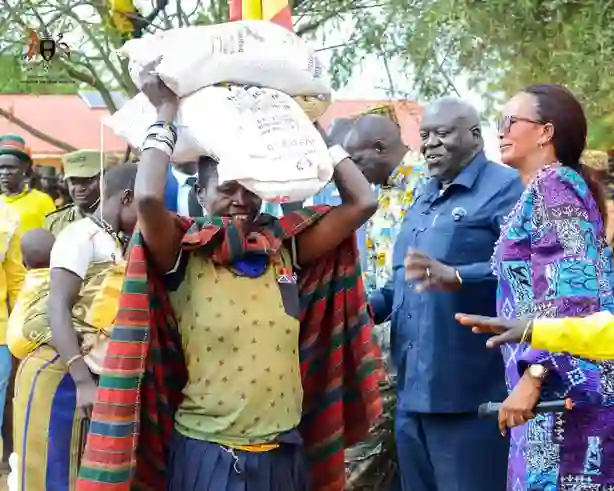
Uganda has begun emergency food distributions in the drought-hit Karamoja region after at least 19 people died from hunger, as authorities race to avert a deepening humanitarian crisis. The government has allocated 9,400 tonnes of relief supplies—procured with a £9 million parliamentary grant—to support 1.5 million people facing acute food shortages following failed rains and widespread crop losses.
Government steps in as aid cuts deepen crisis
The operation, launched by Minister for Disaster Preparedness Sam Engola in Kaabong district, marks Uganda’s largest state-led relief effort in years, filling a critical gap left by reduced international aid. The World Food Programme (WFP) has scaled back assistance to 63% of Uganda’s refugee population, while USAID funding cuts have further strained humanitarian resources.
Engola, speaking at a distribution site in Lodiko sub-county, pledged that no one in Karamoja would be left without support. “The president does not want to hear of anyone in Karamoja dying of hunger,” he said. “I will ensure that everyone receives food.”
Karamoja, one of Uganda’s poorest regions, has endured its worst dry spell in years, with no meaningful rainfall since April—the start of the planting season. The Famine Early Warning Systems Network (Fews Net) has classified the situation as a crisis, with malnutrition rates soaring among children.
Families resort to desperate measures for survival
In Rupa, near Moroto town, 21-year-old mother Angelina Nakiru described the daily struggle to feed her two children after her crops failed. With no alternative income, she joins other women at a makeshift gold-grinding mill, crushing rock for meagre earnings. “The work is dusty and exhausting, but it is the only way I can buy a cup of maize and beans,” she said. “If I don’t, the children will sleep hungry.”
Health facilities in Kaabong and Kotido districts report treating hundreds of severely malnourished children, with a June nutrition report finding nearly half the population in crisis. Environmental degradation, poverty, and low agricultural productivity have exacerbated the region’s vulnerability to climate shocks.
Long-term solutions remain elusive
While the emergency aid offers immediate relief, experts warn it is not a sustainable fix. The government has outlined plans to distribute drought-resistant seeds ahead of the next planting season, alongside a broader Karamoja development strategy aimed at building resilience.
Agnes Kirabo, executive director of Uganda’s Food Rights Alliance, called for systemic reforms to address root causes. “Karamoja possesses adequate rainfall and water routes to achieve food self-sufficiency,” she said. “What is lacking is the political will to invest in water infrastructure and climate resilience.”
With 2,200 hunger-related deaths recorded in 2022, the crisis underscores the urgency of structural change. For now, the focus remains on ensuring the current aid reaches those most in need before the next planting season begins.