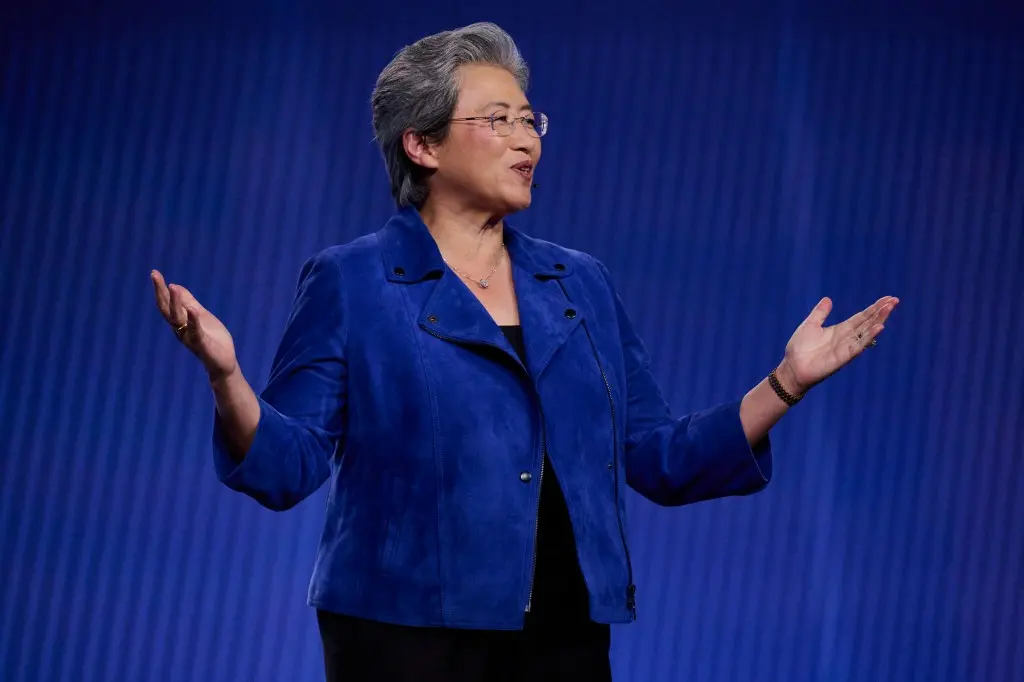
AMD has launched its Helios AI rack-scale system, designed to power the computing needs of the world's largest AI labs, with the company's Chair and CEO, Dr. Lisa Su, promoting the system at the Advancing AI conference in San Francisco on Thursday, where she outlined its capabilities, including its ability to train and run the most demanding frontier models in the world at massive scale, as the system is set to be deployed by leading AI companies, including Microsoft, at gigawatt-scale, later this year.
Challenging Nvidia's Dominance in AI
Nvidia has historically dominated the market for AI rack-scale systems, with its Vera Rubin and Grace Blackwell systems, but AMD's Helios system appears to offer a competitive alternative, with its performance metrics reportedly beating out Vera Rubin in several areas, according to The Register, and with a growing list of customers, including OpenAI, Meta, Oracle, Anthropic, and Microsoft, all of which have plans to deploy the system.
The Helios system, which was first revealed in 2025 and shown onstage in January at CES 2026, is designed to combine many processors into a single high-powered unit, built for data centers, where they train and run AI models and other compute-intensive workloads, and with its ability to handle high-computing workloads, it is well-positioned to meet the growing demand for AI computing power.
Expanding AMD's Product Portfolio
In addition to the Helios system, AMD also introduced its Venice-X CPU, which is designed for data centers and to handle high-computing workloads, and is expected to launch in 2027, as the company continues to expand its product portfolio to meet the growing demand for AI computing power, with Dr. Su commenting on the trajectory of the chip industry, claiming that, by the year 2030, chips that power AI will become a massive part of the overall computing market.
According to Dr. Su, the AI accelerator market is expected to reach about $1.4 trillion by 2030, with GPUs making up the vast majority of that market, due to the algorithms still being in their infancy, and the workloads continuing to change, which favors programmability in the overall silicon ecosystem, and with the company's strategic partnership with Anthropic to deploy up to two gigawatts of GPUs via the new rack system, AMD is well-positioned to capitalize on this growing market.
What's Next for AMD and the AI Market
As the AI market continues to evolve, with the rise of agentic AI driving a step change in compute demand, companies like AMD and Nvidia are likely to play a major role in shaping the future of the industry, and with the launch of the Helios system, AMD is taking a significant step towards challenging Nvidia's dominance in the market, and readers should watch for further developments in the AI rack-scale system market, as well as the impact of the growing demand for AI computing power on the overall semiconductor market.
- The Helios system is designed to train and run the most demanding frontier models in the world at massive scale
- The system will be deployed by leading AI companies, including Microsoft, at gigawatt-scale, later this year
- AMD's Venice-X CPU is expected to launch in 2027
- The AI accelerator market is expected to reach about $1.4 trillion by 2030


