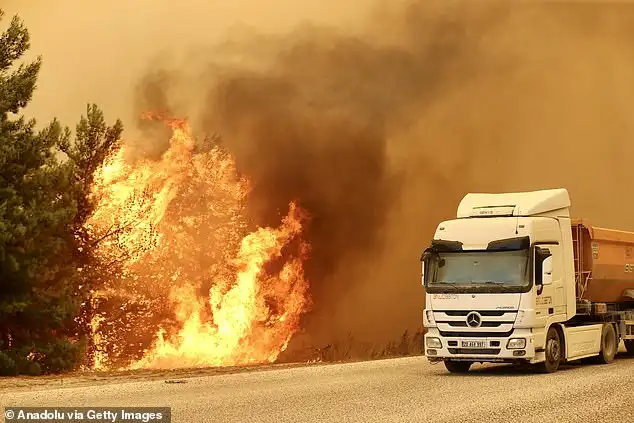
Wildfires have forced the evacuation of nine villages on Greece’s holiday island of Paros and displaced over 220,000 people in France as Europe battles extreme heat and unprecedented blazes. Two firefighters died in Crete after becoming trapped in thick smoke, while temperatures exceeding 40C fuel flames across multiple tourist destinations.
For context: Europe is experiencing its worst wildfire season in living memory, driven by record-breaking heatwaves and prolonged drought. Scientists link the intensifying fires to human-caused climate change, which has dried vegetation and created tinderbox conditions across the continent.
Greece Struggles as Fires Spread on Paros and Crete
Emergency crews on Paros have been battling the blaze since Tuesday afternoon, with 66 firefighters, five helicopters, and two water-bombing planes deployed. The fire has split into two fronts, advancing toward Faragas Beach and Trypiti, while strong winds hamper containment efforts. Deputy Mayor Haris Giourtzidis confirmed two barns have burned but said the full extent of damage remains unclear.
Residents in affected villages—including Agkairia, Trypiti, and Glyfa—were ordered to flee to beaches or nearby islands. One evacuee told Swiss outlet Blick the fire spread “further south with the wind in just three hours,” calling it a “real catastrophe.” On Crete, two firefighters, aged 28 and 60, died after losing orientation in thick smoke while battling flames in Rethymno. Six villages were evacuated as 156 firefighters worked to control the blaze.
France and Spain Face Economic Fallout as Blazes Rage
In France, over 220,000 people have been evacuated near Bordeaux, where the largest wildfire since 1949 has destroyed 240 homes. Firefighters cut a 25-kilometre firebreak on the Cap-Ferret peninsula, but flare-ups continued overnight. Finance Minister Roland Lescure warned of an “economic thunderbolt,” with tourism-dependent regions facing severe losses. One tour guide reported cancellations surging, saying, “This is the busiest time of year. We are looking at a severe financial hit.”
Spain has also seen mass evacuations, with 60,000 people forced from their homes near Madrid. While some evacuation orders were lifted Tuesday, thick smoke still blocked returns. A 55-year-old resident waiting to check on her animals said, “You could see the smoke from here. Even with a mask, you can’t breathe.” The fires have scorched 190,000 acres—an area nearly the size of New York City.
Heatwave Fuels Fears of Worsening Crisis
Temperatures are set to climb further this week, with France and Spain bracing for a fourth heatwave. EU crisis management chief Hadja Lahbib warned of “extreme conditions” looming for Hungary, Slovakia, and the Czech Republic, stretching already strained firefighting resources. French President Emmanuel Macron called the coming weeks “tough,” while Spain’s Prime Minister Pedro Sánchez described the fires as “the most painful expression of a climate emergency.”
Scientists attribute the crisis to climate change, which has parched landscapes and created ideal conditions for wildfires. With no immediate relief in sight, authorities urge vigilance as the continent faces one of its most challenging fire seasons on record.