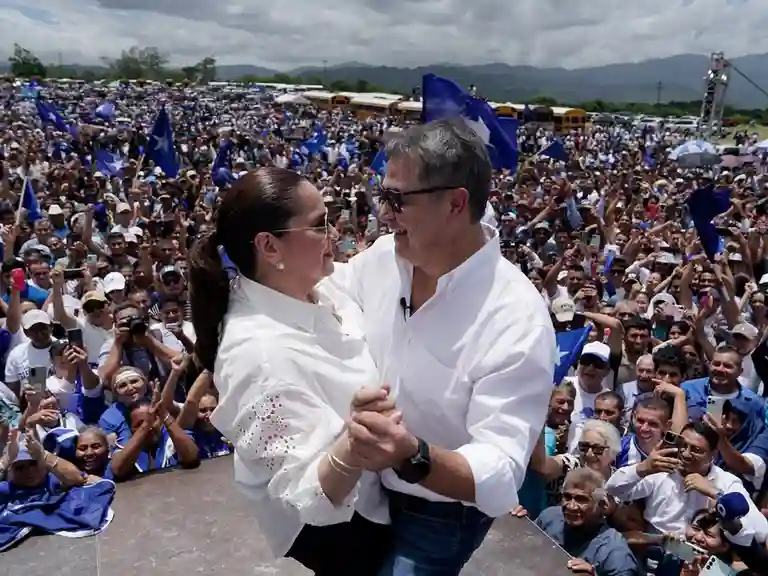
Former Honduran President Juan Orlando Hernandez returned to his home country Sunday, nearly four years after his extradition to the United States to face drug-trafficking charges. His release followed a pardon granted by former US President Donald Trump late last year.
Hernandez's Return to Honduras
Hernandez arrived at Palmerola International Airport and was met by family members and supporters from his National Party. The return was made possible after an arrest warrant against him was cancelled in Honduras last month.
The former president, who served from 2014 to 2022, still faces corruption charges within Honduras. His impending court appearance is scheduled for August 3.
The US Pardon and Trump's Rationale
Donald Trump issued a pardon to Hernandez in December, asserting that the former Honduran leader had not received a fair trial in the United States. Trump claimed the trial was a "set up" orchestrated by the administration of former President Joe Biden, stating Hernandez was "treated very harshly and unfairly."
Under the US Constitution, a president has the power to grant clemency for federal crimes through pardons or commutations. A pardon forgives federal charges and restores civil liberties, while a commutation reduces a sentence without overturning a conviction.
Background of the US Charges
Hernandez was extradited to the US shortly after leaving office. He was convicted by a federal jury on charges related to his alleged involvement in a scheme to export cocaine to the United States. US prosecutors described the operation as "one of the largest and most violent drug trafficking conspiracies in the world."
Prosecutors alleged that over an 18-year period, Hernandez accepted millions of dollars in bribes from drug-trafficking organizations. These funds were reportedly used to support his political ascent. The US Department of Justice stated that Hernandez "abused his powerful positions and authority in Honduras to facilitate the importation of over 400 tons of cocaine into the US."
During his trial, Hernandez denied the allegations, maintaining that his administration had actively combatted the narcotics trade and cooperated with the US military.
Concerns Over Home Soil Trial
Human rights activists and lawyers have expressed significant apprehension regarding a potential trial in Honduras. They fear that given the ruling party's political influence, a trial on home soil could be compromised and not be a fair proceeding.
The Pandora Papers, an investigative journalism project, also accused Hernandez of diverting nearly $11 million in state funds to political campaigns between 2010 and 2013. At the time of his extradition and conviction, Hernandez's political party held the presidency in Honduras.
The Trump administration's decision to pardon Hernandez has drawn criticism, particularly in light of actions taken against other foreign leaders. Notably, former Venezuelan President Nicolas Maduro and his wife were taken into US custody on drug and gun charges in January.
Trump also endorsed Nasry “Tito” Asfura, a member of Hernandez’s party, in the November presidential election. Asfura was declared the winner of the closely contested race in December.