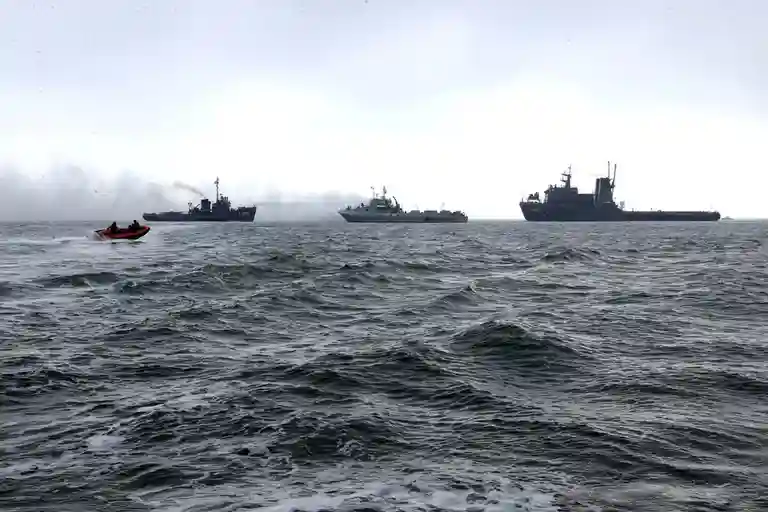
Diplomatic efforts to de-escalate tensions between the US and Iran have paused military strikes for a third consecutive day, as President Donald Trump claims "very friendly negotiations" are underway—though Tehran denies direct talks and threatens retaliation against Ukraine over a disputed Caspian Sea tanker strike.
Trump claims progress in Iran talks as Tehran rejects direct negotiations
President Trump announced on Monday that "very friendly negotiations" with Iran were progressing, following a pause in US military action at the request of mediating nations. "All of the people that deal with Iran asked me: ‘Don’t fire,’" he told reporters aboard Air Force One, adding that the US would resume "very strong military action" if diplomacy fails. However, Iran’s foreign ministry spokesperson, Esmaeil Baqaei, dismissed Trump’s characterization, stating that only messages were being exchanged via mediators, with no direct talks taking place.
The White House reinforced its military readiness, with spokesperson Anna Kelly asserting that US stockpiles remained sufficient for "all of President Trump’s strategic goals and beyond." Trump himself claimed the US possessed "more than we could ever use" in ammunition, though he acknowledged a preference for increased production. The pause in hostilities follows nearly two weeks of daily exchanges between the two nations, which had previously accused each other of violating a June memorandum of understanding.
Caspian Sea tanker strike sparks Iran-Ukraine tensions
Iran has vowed retaliation after accusing Ukraine of a missile strike on an Iranian commercial vessel in the Caspian Sea, which Kyiv claims targeted Russian warships transporting Iran-linked military cargo. Foreign Minister Abbas Araghchi described the incident as an "act of aggression" during calls with EU and Russian counterparts, warning it "cannot go unanswered." Ukrainian President Volodymyr Zelensky confirmed the strike on Saturday, framing it as part of broader efforts to disrupt Russian supply lines.
The dispute adds a new dimension to the Iran-US conflict, with Tehran positioning itself as a neutral party while condemning Ukraine’s expansion of the Russia-Ukraine war. The Caspian Sea, a critical route for energy and military logistics, has become a flashpoint amid broader regional instability.
Shipping disruptions persist as Oman-Iran talks advance
Maritime tracking data reveals reduced traffic through the Strait of Hormuz, with just 29 verified vessels transiting between July 24-26—down sharply from pre-conflict levels. Meanwhile, the Bab al-Mandeb Strait saw 100 transits in the same period, though Houthi rebels in Yemen have signaled intentions to replicate Iran’s Hormuz strategy by disrupting Red Sea shipping. Yemen’s foreign minister-designate, Afrah Al-Zouba, warned that insufficient international responses had emboldened the group to "shut down two main straits."
Oman and Iran are reportedly nearing an agreement on managing the Strait of Hormuz, though disputes remain over Tehran’s proposal to impose transit fees. The talks, backed by China, Qatar, and Pakistan, are believed to have influenced the US decision to pause strikes. Despite progress, analysts caution that Europe’s gas reserves—already at "historically low levels" due to the conflict—could face further strain this winter, with Wood Mackenzie warning of "elevated prices through 2027."
What happens next in the Iran-US standoff
The coming days will test whether the diplomatic pause holds or gives way to renewed hostilities. Key developments to watch include Iran’s response to the Caspian Sea incident, the outcome of Oman-mediated talks, and any shifts in Houthi activity in the Red Sea. With European energy security already under pressure, the conflict’s economic ripple effects may soon eclipse its military dimensions.