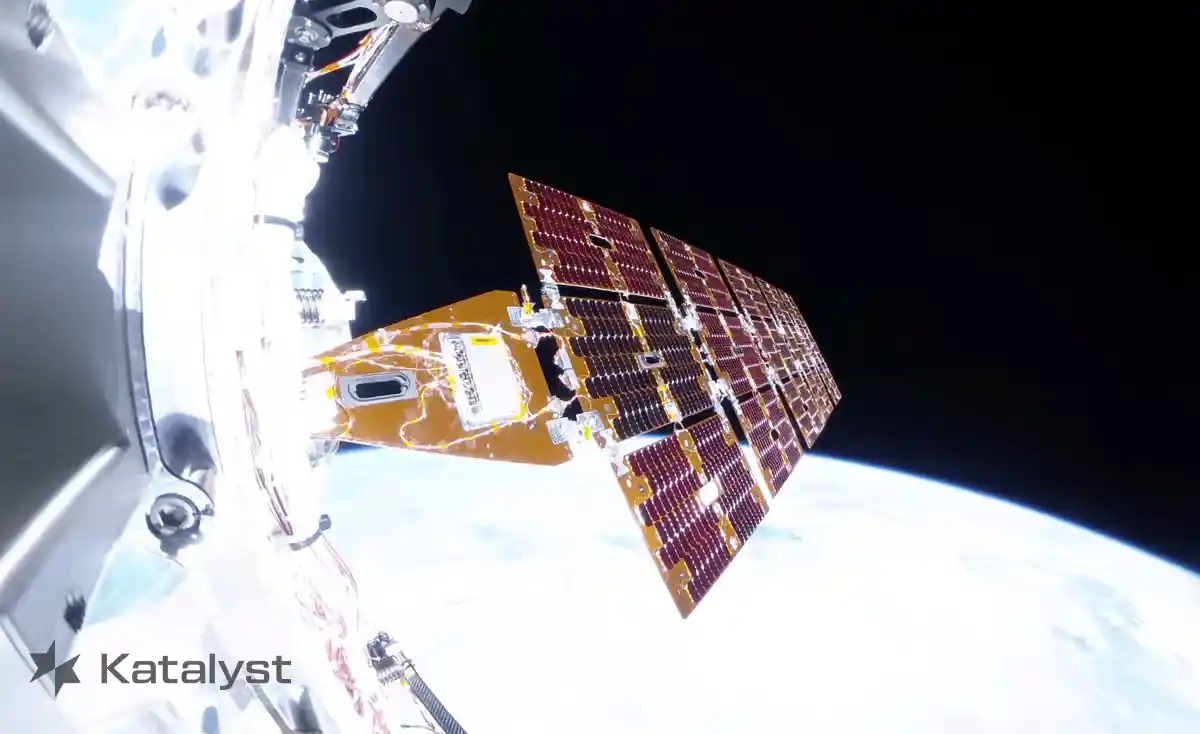
A robotic spacecraft deployed by NASA to elevate the orbit of the Neil Gehrels Swift Observatory is now tumbling uncontrollably, officials from NASA and its private partner, Katalyst Space, confirmed today.
Spacecraft Suffers Control Failures
The mission marked a significant milestone as the first time NASA contracted a private company to perform an orbital boost for one of its observatories. This task was intended to extend the operational life of the Swift Observatory, which was launched in 2004.
The Neil Gehrels Swift Observatory, renowned for its ability to rapidly target transient cosmic events like gamma-ray bursts, has been drifting into a lower orbit. To continue its scientific functions, it requires a propulsion to a higher orbit.
LINK Spacecraft Commissioning Hits Snag
The Katalyst Space LINK spacecraft was launched on July 3 aboard a Northrop Grumman Pegasus rocket. Following its launch, flight controllers spent several weeks activating and testing its systems in preparation for rendezvous with the Swift Observatory.
However, the spacecraft encountered significant issues with its attitude control system, beginning to spin uncontrollably over the weekend. This rapid rotation has hampered communications, as the spacecraft's antenna is not consistently pointed toward Earth. NASA reported that two of the three reaction wheels critical for maintaining alignment have failed, and a problem has also been identified with one of its thruster systems.
Efforts Underway to Stabilize Spacecraft
Flight controllers are actively working to regain control of the tumbling robot. They are employing a secondary set of thrusters to reduce the spacecraft's spin rate. In a statement, NASA indicated that "we have already begun this series of burns and are seeing the intended effect."
Katalyst's chief engineer for the mission, Kieran Wilson, had previously noted the accelerated development timeline for the LINK spacecraft due to the urgency of the Swift mission. He acknowledged the inherent challenges and risks involved, stating that "all this is challenging and risky." Wilson pointed out that many spacecraft with longer development cycles and greater funding have experienced failures for less complex reasons.
Katalyst secured $12 million in funding in June, supported by investors Fortitude Ventures and Geodesic Capital, to aid in this mission. The company has also received backing from the U.S. military, which has expressed interest in its capabilities for servicing satellites and observing rival spacecraft.