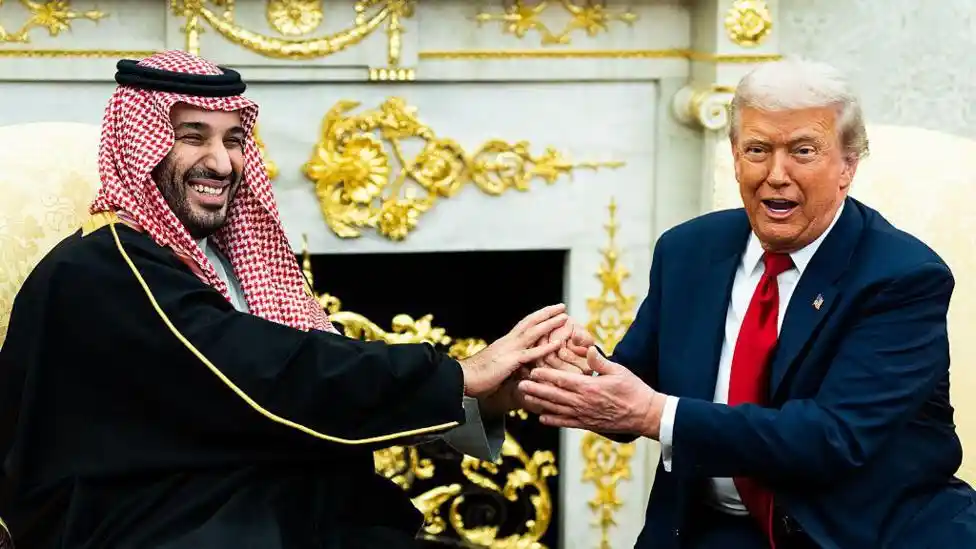
Former US President Donald Trump has asserted that the civil nuclear co-operation agreement between the United States and Saudi Arabia is contingent upon Riyadh joining the Abraham Accords and formally recognising the State of Israel. This condition was communicated by Trump via a post on the social media platform Truth Social.
US-Saudi Nuclear Cooperation Hinges on Abraham Accords
Mr. Trump elaborated in his statement that the civil nuclear deal, which he specified would not involve the enrichment of material for military purposes, would proceed only if Saudi Arabia becomes a signatory to the Abraham Accords. He described the accords as "very respected and successful."
These remarks follow scrutiny from some experts who have voiced concerns that the agreement could potentially increase the risk of nuclear proliferation within an already volatile region. Saudi Arabia has historically maintained a position that it would not recognise Israel unless a Palestinian state is established.
Background of the Abraham Accords and Regional Diplomacy
The Abraham Accords were brokered by Donald Trump in 2020, establishing a framework for the normalisation of relations between Israel and two Arab nations, the United Arab Emirates and Bahrain. Since their inception, Sudan, Morocco, and Kazakhstan have also become parties to these accords.
As of this reporting, Saudi Arabia has not issued a public response to President Trump's pronouncements. It remains unclear whether the stipulation of joining the Abraham Accords was an explicit component of the nuclear deal's text, which has not been publicly released, or if Saudi Arabia had previously assented to such a condition.
Israeli Reaction and Nuclear Capabilities
The office of Prime Minister Benjamin Netanyahu responded to the development via X, stating that Saudi Arabia’s participation in the accords "would be an historic leap forward for peace in the Middle East." The statement did not directly reference the nuclear agreement.
Earlier comments from Israeli Economy Minister Nir Barkat suggested that his country "can manage it" should Saudi Arabia develop nuclear power for peaceful applications. It is widely believed, though not officially confirmed or denied by the Israeli government, that Israel possesses nuclear weapons.
Details of the US-Saudi Nuclear Agreement
The agreement, announced on Wednesday, has been characterised by the US Department of Energy as a "peaceful nuclear co-operation agreement." The department indicated it would grant "great access for American companies in the Saudi nuclear energy programme."
The issue of nuclear capabilities has been a central point of contention in the prolonged diplomatic engagement between the United States and Iran. Crown Prince Mohammed bin Salman, the de facto ruler of Saudi Arabia, stated in a 2018 interview with CBS News that his nation had no immediate plans to acquire nuclear weapons. However, he added that "without a doubt if Iran developed a nuclear bomb, we will follow suit as soon as possible."
Previous reports in the American media had suggested that the deal could permit Saudi Arabia to enrich uranium, a substance used in both nuclear power plants and, potentially, nuclear weapons. President Trump's recent comments appear to dispute such interpretations.
Congressional Review and Potential Opposition
The agreement is scheduled to be presented to the US Congress for its review. It is anticipated that a number of lawmakers from both major political parties may express opposition to the deal. However, with the Republican Party, Mr. Trump's party, holding a majority in both legislative chambers, opponents currently lack the sufficient votes to impede its approval.