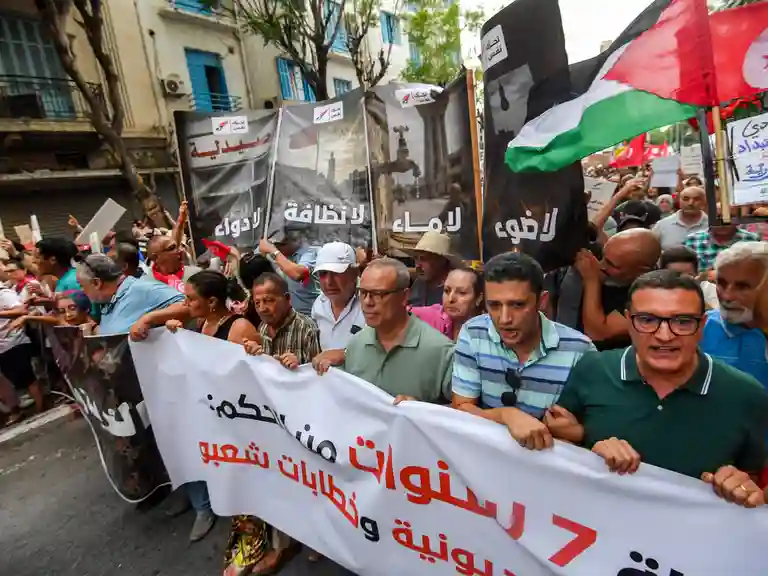
Five years after Tunisian President Kais Saied suspended parliament and seized near-total control, the country faces economic collapse, political repression, and mass protests. Since his July 2021 power grab, Tunisia’s GDP growth has stalled, unemployment has surged, and food inflation has tripled, pushing thousands into the streets to demand his resignation.
The anniversary of Saied’s move—dismissing Prime Minister Hichem Mechichi and freezing parliament—has reignited debate over his leadership. Supporters call it a necessary “correction” to restore stability, while critics accuse him of dismantling democracy and deepening Tunisia’s economic crisis. Both sides agree on one thing: the country is worse off than it was five years ago.
Economic Collapse and Failed Promises
Tunisia’s economy has deteriorated sharply under Saied’s rule. Investment rates plummeted from 20% of GDP between 2015 and 2019 to just 8% in 2023, according to economics professor Ridha Chkoundali. He blames a hostile business climate, rising taxes, and populist policies that prioritize short-term revenue over growth.
Ordinary Tunisians bear the brunt of the crisis. Food inflation has soared to nearly three times the general rate, eroding purchasing power. Unemployment, especially among university graduates, has driven many to emigrate. Former minister Mohamed Abbou argues Saied’s governance has replaced the rule of law with intimidation, undermining investor confidence.
- Investment rate: 20% (2015-2019) → 8% (2023)
- Food inflation: Nearly 3x general inflation rate
- Public sector hiring frozen, imports slashed under IMF-style austerity
Political Repression and International Condemnation
Saied’s consolidation of power has drawn global criticism. The U.S. Congressman Joe Wilson accused him of turning Tunisia into a “one-man dictatorship,” citing corruption, youth unemployment, and alliances with Russia, Iran, and Hezbollah. Wilson urged the State Department to issue a “Level 4: Do Not Travel” advisory, citing the detention of U.S. citizens and political opponents.
Protests on Habib Bourguiba Avenue marked the anniversary, with thousands demanding Saied’s ouster and the release of political prisoners. Among them is Rached Ghannouchi, the 85-year-old Ennahdha leader sentenced to life in prison. His health has deteriorated in sweltering prison conditions, where temperatures reportedly reached 52°C (126°F). Rights groups warn of worsening conditions for elderly detainees.
What Happens Next?
Tunisia’s future hinges on whether Saied can stabilize the economy or if opposition pressure forces concessions. His rejection of an IMF deal—while quietly adopting its austerity measures—has left the country in limbo. Analysts say the political class’s decade-long failure to address economic woes set the stage for the current crisis, but Saied’s policies have only deepened it.
With protests growing and international scrutiny intensifying, the coming months will test whether Tunisia’s democracy can be restored—or if the country’s downward spiral will continue.



.jpg?crop=1080,720,x67.2,y0&trim=0,133,0,67&width=1200)