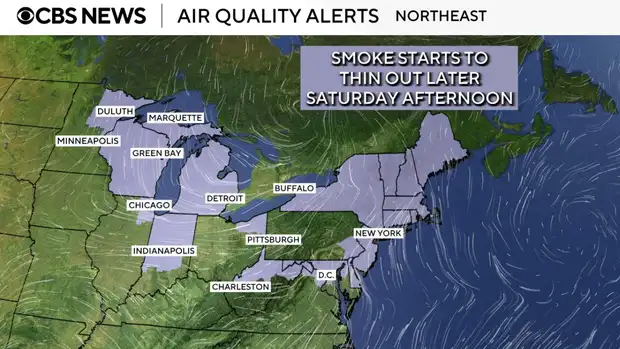
Wildfire smoke from Canada and northern Minnesota has swept across the US Midwest and Northeast, exposing millions to hazardous air pollution and prompting widespread air quality alerts. Conditions in the Northeast are expected to improve by Saturday afternoon as a cold front moves through.
Air quality alerts stretch from Minnesota to East Coast
Hundreds of wildfires continue to burn in Canada, with winds carrying smoke southeastward, while multiple blazes rage in northern Minnesota. Fine particulate matter from the smoke poses significant health risks, particularly for children, the elderly, and individuals with heart or lung conditions.
New York City and Washington, D.C., ranked among the world’s most polluted major cities on Saturday morning, with the latter under a Code Purple alert—deemed "very unhealthy" for all residents. Pennsylvania downgraded its alert from Code Purple to Code Orange, while Michigan and Wisconsin also issued warnings. Tens of thousands attending the World Cup final in New Jersey on Sunday may see improved conditions for the Spain vs. Argentina match.
Health risks and safety recommendations
Experts advise limiting outdoor activities, wearing N95 masks if exposure is unavoidable, and maintaining clean indoor air by closing windows and using purifiers. Long-term exposure to fine particulate matter from wildfire smoke is linked to chronic health issues and premature death, according to recent studies.
Dr. Alexander Azan of NYU Langone Health warned that prolonged exposure increases the risk of developing chronic conditions. Meanwhile, Dan Westervelt of Columbia University’s Climate School noted that severe drought and heat have created ideal conditions for wildfires to spread.
Impact on transport and political tensions
A dramatic video captured a freight train in Ontario surrounded by a wall of flames, forcing a temporary suspension of rail operations. Additionally, former President Trump threatened tariffs on Canada over the wildfire smoke, while Canadian officials stated they are working urgently with provincial partners to address the crisis.