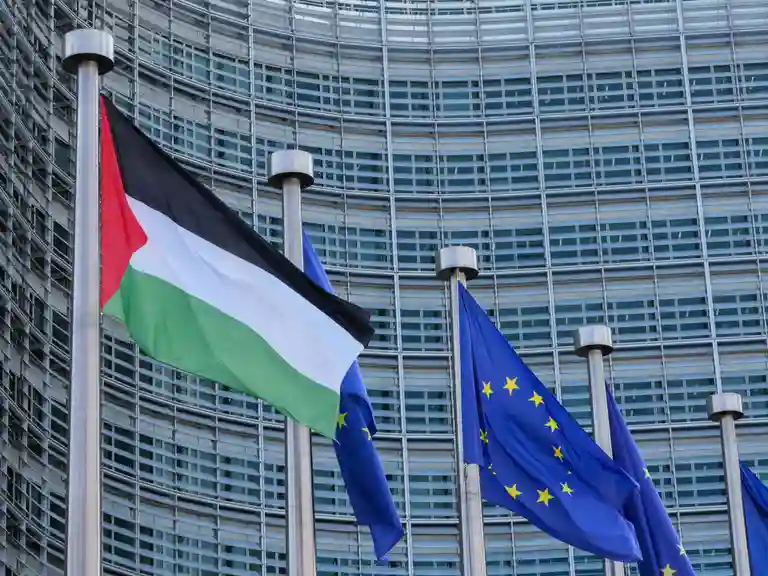
Belgium’s federal government has approved a ban on importing goods produced in Israeli settlements in the occupied Palestinian territories, becoming the latest European nation to act unilaterally on an issue still unresolved at EU level. The decision, announced at the cabinet’s final meeting before the summer recess, fulfils a pledge made last year in response to Israel’s bombardment of Gaza and its mounting death toll.
Belgium’s move amid EU inaction on settlement goods
The ban follows a push by Belgian Foreign Minister Maxime Prevot, who earlier this week urged EU counterparts at a closed-door Brussels meeting to adopt a bloc-wide prohibition. Prevot criticised the European Commission for offering ministers “a bone to chew on” rather than a concrete plan, underscoring the institutional deadlock preventing a unified approach.
Belgium’s action reflects both a domestic commitment and a signal to EU leadership, as member states increasingly bypass Brussels to impose their own restrictions. The case for stricter controls was bolstered by a Global Echo Litigation Center investigation, which analysed over 30,000 export documents covering Israeli agricultural shipments to Europe. Findings revealed that roughly one in six shipments contained goods from settlements in the occupied West Bank or Golan Heights, with the figure rising to nearly one in five for EU-bound cargo.
Widespread mislabelling and EU trade ties with Israel
Investigators found exporters frequently obscured the true origin of settlement goods, either by labelling them as Israeli, blending them with other produce, or using unrelated addresses. The EU remains Israel’s largest trading partner, accounting for nearly 30% of its exports and a third of its total goods trade—worth €43 billion ($49bn) in 2023.
Belgium joins Spain, the Netherlands, and Slovenia in enforcing national bans, though Slovenia’s stance has shifted under a new, more pro-Israel government. Ireland’s parliament also passed a prohibition on July 15, days before Belgium’s announcement. The European Commission recently proposed three options to member states—a ban, a licensing scheme, or high tariffs—but no consensus was reached.
Calls for EU-wide action grow
Five former European officials, including ex-Italian Prime Minister Enrico Letta and former German Vice Chancellor Sigmar Gabriel, have publicly urged the EU to adopt a bloc-wide ban. They argue that national measures carry limited weight, as goods cleared in one member state can still circulate freely across the bloc. Such a ban, they contend, would align EU trade policy with existing restrictions on conflict minerals and forced labour goods, rather than constituting a sanction against Israel.
Several EU countries, including Spain, Italy, and Germany, have also restricted arms exports to Israel amid the ongoing Gaza war. The divide among the bloc’s 27 members continues to hinder decisive action, leaving national bans as the primary tool for states seeking to address the issue.