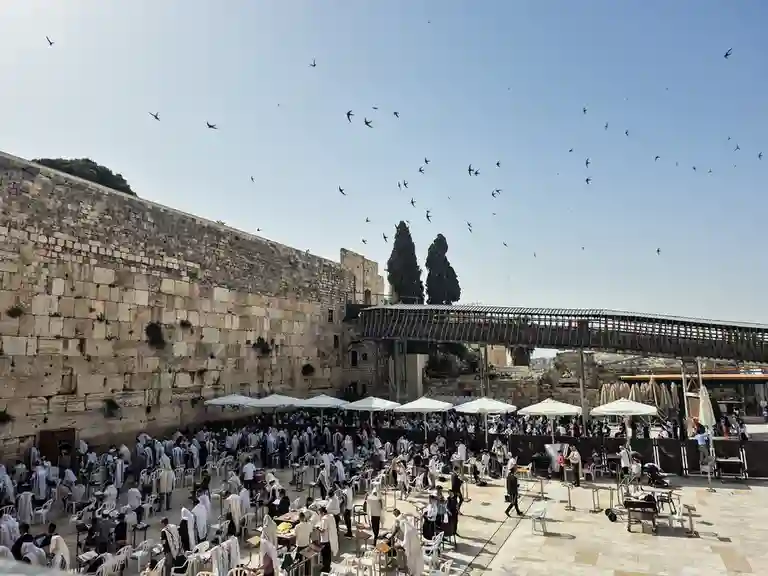
An Israeli paraglider is leading efforts to save migrating common swifts that have nested in Jerusalem’s Western Wall for centuries, with at least 88 active nests documented in the holy site’s ancient stones.
Ancient Tradition at the Western Wall
Every spring, the arrival of swifts from Africa—after a 2,800-mile migration—coincides with religious ceremonies at the Western Wall. The birds, believed to have nested there since Herodian times, are celebrated in biblical texts, including Jeremiah’s reference to their punctual migrations. Worshippers like Sarah Wurtzel, an Israeli resident from New York, describe the swifts as a spiritual symbol, deepening their connection to faith.
The birds’ presence extends beyond the Western Wall, nesting at other sacred sites like the Al-Aqsa Mosque and the Church of the Holy Sepulchre. British artist Mark Coreth even created sculptures of swifts as symbols of unity, displayed in Jerusalem’s Old City and Gaza.
Declining Swift Populations and Conservation Efforts
Swifts in Israel face threats from modern construction, which eliminates nesting spaces. Amnonn Hahn, chair of the Friends of the Swifts Association, notes that glass facades and sealed buildings leave the birds with fewer options, forcing them into inadequate gaps. Nestlings often fall from these cramped spaces, prompting Hahn to rescue and relocate them to safer, man-made nesting boxes.
Hahn’s work began after witnessing swifts’ distress during a school renovation in 2005. He installed nesting boxes—some repurposed from Israeli army ammunition crates—across Tel Aviv and other cities. His efforts include a Tel Aviv kindergarten with 222 boxes, where swifts perform “screaming parties” to encourage fledglings to take flight.
A Lifelong Bond with the Swifts
Hahn’s passion for swifts traces back to a 1999 paragliding championship, where he flew alongside the birds for 25 minutes at 6,500 feet. The experience inspired his conservation work. Despite challenges like missile strikes disrupting nesting sites, Hahn’s boxes ensure swifts return to safe spaces each year.
Swifts mate for life but migrate separately, reuniting at the same nesting sites annually. They spend most of their lives in flight, eating, sleeping, and even mating mid-air. Hahn’s nesting boxes aim to preserve this cycle amid urban development.




