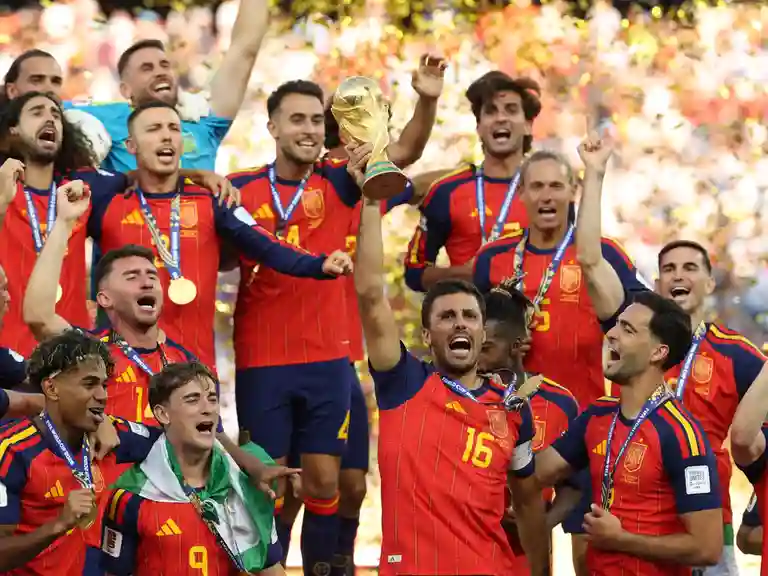
Spain defeated Argentina 1-0 in extra time to win the 2026 World Cup final, securing its second title and reinforcing its dominance in international football. The victory capped a tournament where La Roja conceded just one goal in eight matches, showcasing a possession-heavy style that stifled opponents, including Lionel Messi’s Argentina.
How Spain controlled the 2026 World Cup final
Spain’s strategy relied on ball mastery and precision passing, limiting Argentina’s attacking opportunities. Messi, a focal point of pre-tournament hype, was largely neutralized, while Spain’s defense—led by Pau Cubarsi and Aymeric Laporte—held firm. Goalkeeper Unai Simon’s anticipation thwarted Messi’s early run, mirroring his performance against Kylian Mbappé in the semifinals.
The decisive moment came when Pedro Porro’s cross set up Ferran Torres’ extra-time winner. The sequence began with Lamine Yamal’s layoff to Porro, whose curling pass found Nico Williams, who headed down for Torres’ left-foot finish. Williams, a late-game spark, had a 96th-minute goal disallowed but terrorized Argentina’s Nahuel Molina with his dribbling.
Standout performers and key stats
Rodri, despite zero goals or assists, was named Ballon d’Or winner for his midfield control and tempo-setting ability. The 19-year-old Cubarsi, dubbed “Cubarsito,” earned the Young Player award, joining Giuseppe Bergomi as the only teenage starting center-backs to win a World Cup.
- Spain conceded 1 goal in 8 matches (Charles De Ketelaere’s header for Belgium in the quarterfinals).
- Cubarsi’s challenge led to Enzo Fernández’s red card, giving Spain a man advantage in stoppage and extra time.
- Rodri was subbed off in the 99th minute but remained influential, matching his 2024 Ballon d’Or form.
World Cup 2026: A tournament of firsts and flaws
FIFA President Gianni Infantino called this the “greatest World Cup of all time,” though its expanded 48-team format stretched the tournament to 104 games over five weeks. The final itself featured two hydration breaks and a 27-minute halftime show, which some argued diluted the drama. For Messi, the loss echoed past heartbreak: Argentina fell to Chile in the 2015 and 2016 Copa América finals and to Germany in the 2014 World Cup.
Spain’s triumph underscores the rarity of back-to-back World Cup wins, a feat no team has achieved in the modern era. The result leaves Argentina—despite Messi’s legacy—still chasing a second title.