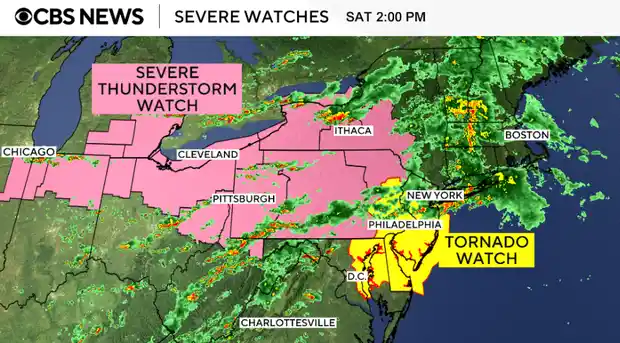
Thunderstorms moving through the Northeast are expected to clear most of the Canadian wildfire smoke from the New Jersey area ahead of Sunday’s World Cup final between Spain and Argentina, meteorologists have confirmed.
While air quality warnings remained in effect across much of the United States on Saturday, the storm front is projected to push the thickest haze out of the region before the match. Tyler Roys, a senior meteorologist at AccuWeather, noted that only faint lingering smoke may persist, with the dense, health-hazardous conditions unlikely to affect New York City or the broader Northeast by kickoff.
Storm systems bring rain and flooding risks
The National Weather Service reported that early Sunday would see further rain in the Mid-Atlantic, with a stalled front delivering locally heavy downpours to eastern North Carolina. Three-day rainfall totals of 3-5 inches are anticipated in the region, while another storm system is forecast to enter the Mid-Atlantic on Tuesday and Wednesday, raising the risk of additional flash flooding.
Severe weather had already disrupted parts of the Ohio Valley, Mid-Atlantic, and Northeast, with cities including New York, Washington D.C., Philadelphia, Pittsburgh, and Cleveland experiencing damaging winds, large hail, isolated tornadoes, and flash flooding. Urban areas with high runoff face the greatest flood risks, and the storms had already caused cancellations, including singer-songwriter Noah Kahan’s concert at Citi Field on Saturday night.
Air quality and health impacts
Improving conditions are expected as the cold front progresses, though heavy smoke from wildfires in Canada and Minnesota has blanketed the Midwest and Northeast this week, affecting at least 19 states. The New Jersey Department of Health reported that 71 individuals sought emergency or urgent care for asthma or asthma-like symptoms on Saturday, a figure within the typical daily range prior to the smoke’s arrival.
Former professional soccer player and MLS analyst Sacha Kljestan told CBS News that while FIFA is unlikely to postpone the final, poor air quality could still slow the pace of the game. Meanwhile, recovery efforts continue in Texas after deadly flooding, where some rivers remain dangerously high and the National Guard has conducted air rescues.




