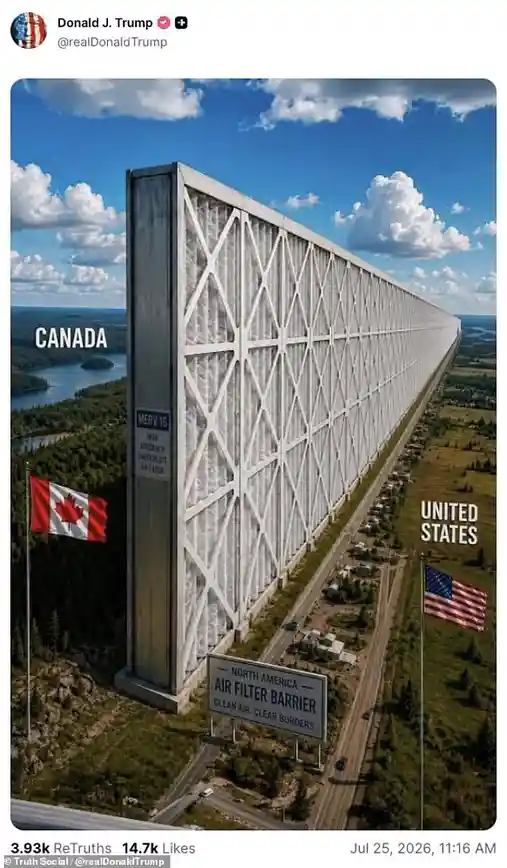
US President Donald Trump has intensified his confrontation with Canada over cross-border wildfire smoke, unveiling an AI-generated concept for a "North America Air Filter Barrier" along the northern border and imposing 50% tariffs on Canadian exports ranging from wine to hockey sticks.
The escalation, announced via Truth Social on Saturday and formalised in a White House fact sheet on Monday, follows weeks of rhetoric in which Trump accused Canada of "poisoning" American air through inadequate forest management. The tariffs, set to take effect in 30 days, mark the first time environmental concerns have been cited as justification for trade penalties under the current administration.
AI-Generated Border Filter Sparks Diplomatic Backlash
The proposed air filter barrier, depicted in a digital rendering shared by Trump, shows an industrial-scale furnace filter stretching across the US-Canada border. A caption beneath the image reads: "Clean Air. Clear borders." While administration officials have not released engineering assessments, the concept has drawn immediate criticism from environmental engineers and trade experts.
Canadian Prime Minister Mark Carney, who met with Trump at the World Cup final in New Jersey on Sunday, warned that the tariffs would harm workers on both sides of the border. "We don’t need to respond in advance," Carney told reporters in Charlottetown on Thursday. "In fact, I think it would be counterproductive at this stage to respond in advance." He confirmed that Canada is prepared to retaliate if the measures proceed, though he declined to specify potential counter-tariffs.
Tariffs Target $300bn in Annual Trade Under USMCA
The 50% levies apply to a broad swath of Canadian exports, including:
- Dairy products and honey
- Alcohol and liquor
- Cement and certain wood products
- Hockey sticks and sporting equipment
- Selected manufactured goods
Notably excluded are energy products, potash, fish, and critical minerals—sectors deemed essential to US supply chains. The tariffs override protections established under the United States-Mexico-Canada Agreement (USMCA), which Trump declined to renew in 2020, triggering ongoing negotiations that could extend until 2036.
Carney suggested the tariffs may be a negotiation tactic, citing a pattern of "outsized tariffs associated with deadlines" in US trade talks. "We’ve seen this movie before," he said, while expressing confidence in reaching a deal. The White House has not commented on whether the measures are temporary or part of a broader strategy to renegotiate the USMCA.
Wildfire Smoke Crisis Fuels Unconventional Policy Responses
Trump’s rhetoric has centred on the public health impact of Canadian wildfires, which blanketed US cities in hazardous smoke in July. "Our air’s being poisoned," he told Carney during their World Cup meeting, referencing hospitalisations of Ford assembly line workers in Detroit. The Environmental Protection Agency reported "very unhealthy" air quality in New York, Washington DC, and Michigan during the peak of the smoke event.
The administration has also linked trade policy to other environmental health threats, including a separate proposal to impose tariffs on Mexican lettuce over a cyclosporiasis outbreak affecting 11,000 Americans. Health officials have traced the parasite to shredded iceberg lettuce from Taylor Farms in Mexico, though tests at the facility returned false positives. The company voluntarily recalled products and temporarily closed its Central Mexico site.
Trump’s tariff strategy extends beyond North America. On Friday, the White House announced new duties ranging from 10% to 12.5% on imports from 60 trading partners, including China, India, and the European Union. The move follows a February Supreme Court ruling that struck down several of Trump’s tariff authorities, prompting the administration to exploit alternative legal mechanisms. The latest round of levies, initially proposed in June, covers 99.4% of US trade and has drawn formal protests from Beijing.
Observers are now watching for Canada’s next move, with Carney’s "everything’s on the table" remark suggesting potential countermeasures. The dispute also raises questions about the future of USMCA negotiations, which remain stalled despite Carney’s stated willingness to engage. For now, the 30-day countdown to the tariffs’ implementation leaves both nations in a precarious position, with billions in trade and diplomatic relations hanging in the balance.



