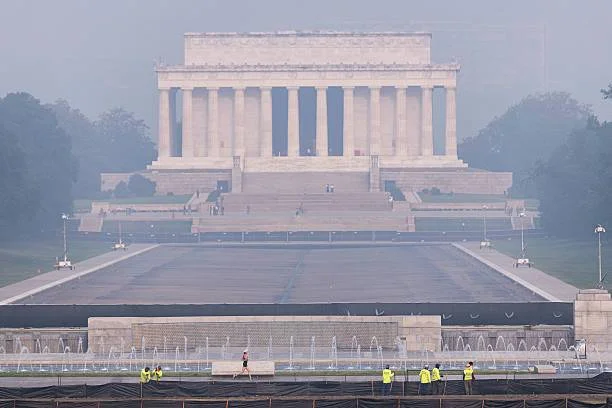
Air quality in the Northeast and Mid-Atlantic is improving as heavy rain and storms help clear smoke from Canadian and Minnesota wildfires, though dangerous pollution levels persist over the Midwest, the National Weather Service (NWS) reported on Saturday.
Midwest faces prolonged wildfire smoke exposure
Smoke from hundreds of active wildfires in Canada and Minnesota continues to spread, enveloping skylines and reducing visibility in cities such as Washington, D.C., where landmarks like the Lincoln Memorial appeared shrouded in haze on July 17, 2026. NWS Forecaster Brian Hurley noted that while conditions in the National Capital Region are easing, with particulate concentrations dropping to a quarter or third of recent levels, the Midwest—including Chicago, upper Michigan, and parts of Wisconsin, Illinois, and Indiana—will receive a fresh wave of smoke through Sunday.
Major League Baseball postponed a game between the Pittsburgh Pirates and Cleveland Guardians on Friday due to poor air quality in Cleveland, rescheduling it for Saturday. Meanwhile, New York City and northern New Jersey, where Sunday’s World Cup final between Argentina and Spain will take place at the open-air MetLife Stadium, are expected to see clearer conditions.
Climate change and political tensions escalate
More than 900 wildfires are currently burning in Canada, particularly in Manitoba and Ontario, bordering the northern U.S. Former President Donald Trump, in a post on Truth Social, accused Canada of failing to manage its forests and threatened new tariffs, stating that the U.S. is being "invaded by filthy, polluted, and unhealthy air." Canadian officials have countered that both nations share responsibility in addressing climate change, which has intensified wildfire risks.
Health risks and protective measures
Health experts warn of the severe impacts of wildfire smoke, likening exposure to "smoking half a pack a day." Peter DeCarlo, a professor at Johns Hopkins University, advised using air purifiers to reduce indoor particulate matter, noting that roughly 50% of outdoor smoke particles can enter homes. Vulnerable groups—children, pregnant women, older adults, and those with pre-existing conditions—face heightened risks.
DeCarlo also recommended N-95 masks for outdoor protection, as they filter both pollution and COVID-19 particles. The NWS issued air quality alerts across New England, with improvements expected before midnight. In Minnesota, over 600 firefighters are battling wildfires in extreme heat, with flames covering more than 70,000 acres and approaching evacuated residential areas. Thunderstorms and potential tornadoes are forecast for the Mid-Atlantic and Northeast this weekend.


